The Fundamentals of Waste Categorization
Defining Organic and Inorganic Waste
In the dim reckoning of South African landfills, a stark division governs everything. Organic waste once pulsed with life; it decays, rots, and can nourish the earth again. Inorganic waste, forged in furnaces and molds, persists across decades. This difference forms the basis of waste management and segregation.
Household refuse reveals the split. Consider what each type demands:
- Organic scraps, leaves, and stale bread can return to soil through compositing
- Inorganic glass, plastic, and metal require reprocessing or eternal storage
When these categories collide, the consequences are grim. Mixed waste becomes a sour mass that releases methane. Sepration at the source, however, allows each stream to follow its own fate.
Hazardous vs. Non-Hazardous Materials
Every South African household produces waste that is not equal in danger. Hazardous materials demand immediate attention because they contain properties that can poison soil, water, or people. A discarded battery, leftover paint thinner, or an old compact fluorescent bulb is not ordinary refuse. These items require separate handling. Non-hazardous waste poses little direct threat. It includes paper, cardboard, and general packaging that can move through standard collection systems.
Here is the practical distinction:
- Hazardous waste includes acids, solvents, pesticides, and medical sharps.
- Non-hazardous waste includes household paper, textiles, and uncontaminated food containers.
The line between the two is not always obvious. In my experience, proper waste management and segregation starts with reading labels and knowing what you discard. When hazardous items slip into general bins, they contaminate entire loads and endanger landfill workers.
Recyclable, Compostable, and Landfill Waste
South Africa sends roughly 90% of its waste to landfill sites, yet most of it belongs in another stream entirely. Categorizing waste at the source is the first test of a functional system.
Recyclable waste includes clean glass, paper, and certain plastics. Compostable material breaks down into soil enhancers. Landfill waste has no recovery path. Contamination destroys value! A greasy pizza box ruins an entire bale of recyclable paper.
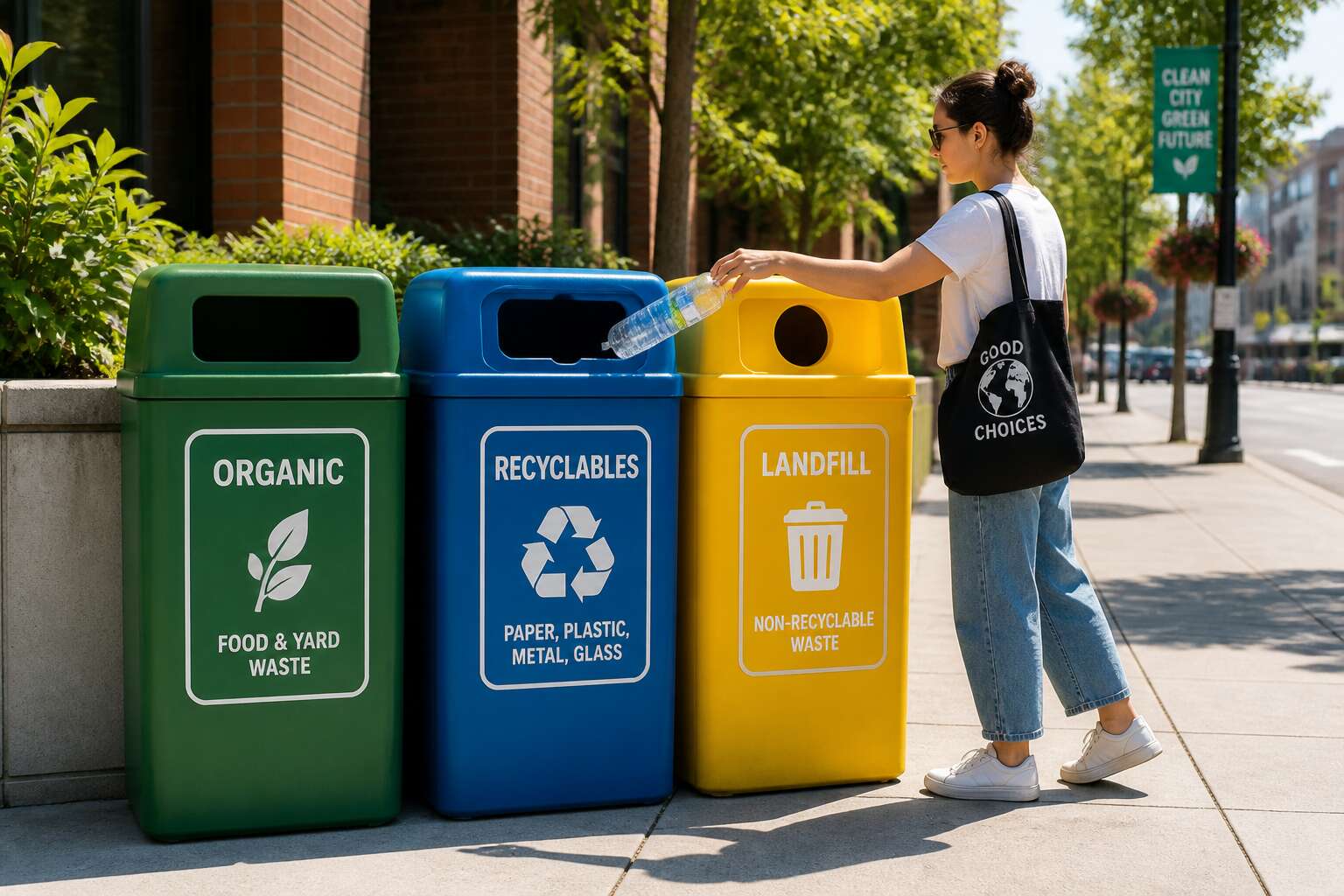
- Recyclable: clean paper, glass, metal tins
- Compostable: fruit peels, vegetable scraps, eggshells
- Landfill: dirty nappies, ceramics, polystyrene
The separation of these streams is not a municipal duty alone. Effective waste management and segregation happens in the home, before the bin reaches the curb. When categories stay pure, material recovery becomes viable and landfill pressure drops.
Home Waste Segregation Techniques
Setting Up a Color-Coded Bin System
South Africa’s landfills are choking. Over 90% of what we throw away ends up buried, though much of it could be diverted with better household systems. A colour-coded bin system brings order to your waste management and segregation routine without demanding extra thought.
Assign one bin per stream and commit to the colours. Many municipalities use blue for recyclables, green for organic matter and black for general waste. Consistency matters more than perfection. Label each bin clearly and position it where the waste is created, not in a forgotten corner. Your kitchen becomes the control centre, not a dumping ground.
If space allows, add extra bins for specific problem items:
- Red for batteries and e-waste
- Yellow for used oil or chemicals
- White for clean paper and cardboard
Composting Kitchen Scraps
Nearly a third of a typical South African bin is organic matter that never needs to leave your property. I keep a countertop crock with a charcoal filter, and every peel and rind goes straight in. The transformation of decomposition turns these scraps into dark, crumbly soil food. My kitchen routine follows a simple rhythm:
- coffee grounds and tea leaves
- eggshells and fruit skins
- chopped vegetable ends
Balancing those wet items with dry leaves keeps the pile healthy. This rhythm is waste management and segregation in its rawest form. With fewer organics in the general stream, the remaining waste becomes cleaner, making every downstream separation easier. Each piece of waste management and segregation done here means a lighter load for the municipal system. That is the effective outcome of composting kitchen scraps at home.
Handling E-Waste Responsibly
That old phone in your drawer is not a keepsake. It holds lithium and lead. Handling e-waste responsibly starts with a simple rule: never mix it with daily rubbish. These items demand a separate stream. That is waste management and segregation.
The real danger hides in harmless parts. Circuit boards and batteries contain heavy metals. When crushed in a landfill, they release toxins. My family keeps a designated box for outmoded cables and dead devices. We take the full box to a certified recycler!
To make this routine stick, follow a simple sequence:
- Set a single e-waste container.
- Remove batteries before storing.
- Erase data from hard drives.
- Drop it at a registered facility.
This discipline shifts the burden to proper channels. Each diverted item protects clean water. That is waste management and segregation done with foresight.
Reducing Contamination in Recycling
The recycling bin is not a trash can’s fancier cousin. In South Africa, a single greasy pizza box can condemn an entire batch of recyclables to landfill. That is waste management and segregation failing at the exact moment it matters most, inside your own kitchen.
Home segregation is a battle against sloppiness. Rinsing a tin takes ten seconds. Squashing a bottle takes one. Yet many households toss in half-full cooldrinks and oily containers, turning a perfectly good load into contaminated refuse. The bin system works only when contents obey the rules. Keep paper dry. Keep plastics empty. Never let bagged rubbish hide inside the recycling stream.
- Empty every container completely.
- Flatten cardboard boxes.
- Keep lids attached to bottles.
That mild obsession with sorting is the difference between a useful resource and a costly mistake. Waste management and segregation is not glamorous, but it is the only honest system we have.
Municipal and Industrial Waste Sorting Processes
Material Recovery Facilities Explained
In South Africa, municipal waste sorting starts with collection, but the decisive stage happens at a material recovery facility, or MRF. These plants combine conveyor belts, screens, and magnets to separate paper, metals, and plastics from mixed refuse. Industrial waste sorting follows a different rhythm, often using air classifiers and density separators to handle bulk byproducts.
- Screening to remove oversized items
- Magnetic separation for ferrous metals
- Eddy current separators for aluminium
- Optical sorting for different polymer types
Effective waste management and segregation depends on how well these facilities match technology to the waste stream. For instance, a MRF processing single-stream recycling will rely more on optical sorters than one handling source-separated loads. The difference matters because contamination levels dictate the final market value of recovered materials.
Single-Stream vs. Source Separation
Single-stream recycling is popular because it is easy. Easy, however, is not the same as clean. South African municipalities often use one bin for paper, plastic, and cans, trusting that MRF screeners and optical sorters will handle the mess. But when food waste and nappies slip through, contamination spreads and buyers pay less.
Source separation takes the opposite route. Households or businesses sort at the point of generation, keeping glass separate from cardboard and hazardous items out of the mix. It asks more of people, yet the recovered material holds its value.
Industrial waste sorting operates on a similar principle. Factories produce bulk byproducts in steady streams, so segregating at the source reduces handling costs. A typical site might:
- Separate polymer types before baling
- Keep metal offcuts in designated skips
- Divert food waste from general refuse
Waste management and segregation involves a trade-off between convenience and quality. Single-stream wins on participation. Source separation wins on value.
Innovations in Mechanical Sorting
Roughly 10% of South Africa’s recyclable waste is recovered. The rest heads to landfill. Mechanical sorting is improving that figure. New facilities combine sensor arrays, air currents, and machine vision to pull value from mixed streams, changing waste management and segregation nationwide.
Municipal plants use near-infrared optical sorters that identify polymer types in milliseconds. Air jets fire flakes into chutes. Newer systems add AI-powered cameras that spot nappies and food waste before they contaminate a bale.
Working systems include:
- Near-infrared sorters distinguishing six or more polymer types
- AI vision systems flagging contamination in real time
- Robotic grippers pulling out items missed by air jets
Industrial sorting follows a different approach. X-ray sorters separate heavy metals. Eddy current separators launch non-ferrous metals clear of the stream. I have watched these systems run in Johannesburg, and the precision is remarkable!
The result is that waste management and segregation now depends more on machine precision than human discipline.
Managing Construction and Demolition Debris
Municipal sorting lines are not built for demolition debris. Concrete dust dulls optical sensors, and rebar jams conveyor belts. Industrial yards, however, run a different approach. Screens and magnets do the heavy lifting first. Then air classifiers and picking stations separate wood, plastic, and clean aggregate.
I watched a facility outside Cape Town process a huge pile of rubble in hours. The recovered steel alone paid for the afternoon’s energy! Good waste management and segregation at the source would have doubled the yield. Instead, workers pulled out everything from paint tins to tangled copper wire.
- Recovered steel is baled and sent to mills.
- Clean concrete is crushed for road base.
- Wood is chipped for biomass fuel.
These systems do not replace human judgment. They shift the point of sorting to a stage where contamination can still be controlled.
Medical Waste Handling Protocols
Every load of waste carries a hidden biography. In Johannesburg’s industrial facilities, sorting lines run with a colder logic than their municipal counterparts. City systems depend on optical sensors and gloved hands. Industrial yards face harsher loads. Shredders break down what the municipality rejects, and magnetic drums pull ferrous metals from the debris. The yield improves when waste management and segregation begins at the source.
Medical waste handling demands even stricter protocols. Clinics and hospitals across South Africa separate sharps, pathological matter, and pharmaceutical residues before any collector arrives. Autoclaves sterilize the infectious load. Incinerators reduce the rest to sterile ash.
- Sharps are packed in puncture proof containers.
- Pathological waste is incinerated immediately.
- Pharmaceutical residues are chemically neutralized.
Each step is documented to the final treatment facility. Waste management and segregation, in this realm, is the thin line between safety and exposure.
Challenges and Solutions in Waste Segregation
Public Participation and Education
Persuading residents to sort their rubbish correctly remains the most stubborn obstacle in any waste management and segregation programme. In South African townships and suburbs alike, apathy often stems from a simple lack of trust that separated materials actually get recycled. This skepticism is not unwarranted.
Several barriers consistently surface:
- Literacy levels vary widely, so written instructions on bins fail many households.
- Informal waste pickers sometimes remove valuable recyclables before collection, confusing residents about where materials ultimately go.
- Municipal budgets rarely stretch to door-to-door education campaigns.
The solutions require creativity. Community leaders who model correct behaviour, school programmes that carry lessons home, and visible feedback loops showing what happens to sorted waste all build momentum. A successful waste management and segregation strategy treats residents as partners, not problems. When people see their efforts producing tangible results, participation becomes habitual rather than forced.
Dealing with Non-Recoverable Residuals
Landfills remain the final resting place for what we cannot reclaim. Even with meticulous source separation, a grim percentage of household waste resists all recovery efforts. This residual fraction, the ash and the dross of consumption, carries the heaviest environmental toll. In South Africa, where landfill airspace shrinks daily, this reality demands a stark confrontation with what we discard.
The challenge lies in the unpredictable composition of this waste stream. Hazardous residues hide inside ordinary bags, while contaminated organics render entire loads unfit for recovery. The solution begins with targeted community education on hazardous household items, paired with dedicated collection points that remove problematic materials before they taint the general flow.
Specific pollutants require specific interventions. A short inventory of common offenders includes the following:
- Batteries and electronic components leaking heavy metals
- Paint cans with residual solvents
- Pressurized gas canisters
- Pharmaceuticals and expired medical supplies
- Asbestos sheeting from home renovations
Separation of these items requires deliberate municipal drop-off events and permanent hazardous waste depots. By removing these damaging elements, the remaining residual waste becomes more homogenous. This simplifies treatment. This permits safer compaction. This reduces the long-term liability of every waste management and segregation plan. The goal is not to eliminate all waste, but to ensure what remains is inert, stable, and manageable for future generations.
Cost-Effectiveness of Segregation Programs
The true cost of waste management and segregation materialises in the failures. Each contaminated load sent for recovery carries a hidden invoice: re-sorting labour, rejected bales, and double landfill fees. South African municipalities often discover that expensive sorting machinery cannot fix what source separation should have solved at the kerbside.
Consider the economics of one contaminated load:
- A single bag of nappies can condemn an entire collection truck to the landfill.
- One paint can renders tonnes of residual material hazardous.
- Misplaced organics drive up leachate treatment and methane capture costs.
The solution is upstream discipline, not downstream machinery. Deposit return schemes create economic pull that draws bottles and e-waste from the general stream. Pay-as-you-throw tariffs make households feel the weight of their choices. As separation improves, collection frequency drops, haulage expenses shrink, and the residual fraction approaches something inert.
Policy and Regulatory Interventions
South African waste policy suffers from fragmentation. The National Environmental Management: Waste Act sets ambitious goals, yet municipal by-laws frequently contradict one another. One municipality may enforce source separation; its neighbour ignores it entirely. This inconsistency erodes public trust and stalls investment in recovery infrastructure.
Extended Producer Responsibility regulations exist, but compliance monitoring remains thin. Producers who pay into the system resent those who do not. Overlapping mandates between national and provincial authorities confuse oversight.
Regulatory interventions must prioritise certainty. A unified national licensing register for waste transporters would curb fly-by-night operators. Binding, audited collection targets would steady the market. We have the legislation. Our enforcement simply needs to catch up with the ambition!
This is the real test of waste management and segregation policy.
Future Trends in Resource Recovery and Circular Economy
Smart Bins and IoT Integration
By 2030, South African municipalities could divert nearly half of their organic waste from landfills if smart bin networks scale beyond pilot projects. I have seen rollouts shift household habits!
Smart bins with ultrasonic sensors measure fill levels. IoT platforms route collection trucks where needed, cutting fuel costs and reducing overflow in townships and business districts. For homes, QR-coded bins let residents check what goes where, which strengthens waste management and segregation at the source.
Circular economy models rely on this data. When a bin signals contamination, the system flags it before the load reaches a facility. Cities are testing reward schemes tied to bin usage.
- Sensor data predicts weekly generation patterns, helping councils plan capacity.
- IoT-enabled scales at drop-off points track per-household diversion.
The next step is linking smart bins to material recovery infrastructure. As connectivity spreads, waste management and segregation becomes less about guesswork and more about precision.
Chemical Recycling Innovations
Chemical recycling innovations are breaking down what mechanical sorting cannot reach. Pyrolysis cracks plastic polymers into synthetic oils. Solvolysis strips pure monomers from contaminated fibres. Methanolysis follows similar lines. By 2035, South African chemical recycling capacity could absorb a meaningful share of the plastic fraction currently lost to landfill. These circular economy processes demand precise inputs. One contaminated bale can ruin an entire reactor run. That is why effective waste management and segregation determines whether these technologies succeed.
Consider what such facilities process:
- mixed packaging no longer limited by colour or composition
- textile blends whose fibres cannot be separated manually
- plastic resins stained by repeated use
Households that sort correctly are feeding tomorrow’s feedstocks. The future of resource recovery depends on this chemistry, and on every hand that sorts at the source.
Zero-Waste Community Models
By 2030, a handful of South African suburbs will produce almost no landfill waste. Zero-waste communities are becoming prototypes for the circular economy future. Residents operate under a simple contract: every item enters the home with a plan for its exit.
Household level shifts are reshaping waste management and segregation on a municipal scale. Neighbourhoods form sharing networks for bulky goods, and block level composting hubs turn food scraps into soil within days. This decentralised approach strengthens the feedstock quality that industrial recyclers depend on. Consider what these communities prioritise:
- Redesigning products to be reusable or refillable from the start.
- Assigning a dedicated bin for organic matter and another for clean, dry recyclables.
The result is a quieter, more deliberate progress, built on trust between neighbours and a shared understanding that sorting at the curb determines what the market can reclaim.
Blockchain for Waste Tracking
Recycling depends on trust. In South Africa, we toss a bottle into the right bin and hope the system honors our effort. Blockchain for waste tracking now makes that hope verifiable. Every bale of recyclables carries a digital ledger, recording where it was sorted, who transported it, and which facility processed it. This transforms waste management and segregation from a civic duty into a transparent transaction.
Consider what this means for resource recovery. A manufacturer buying recycled polymer can trace its journey to a specific curb in Johannesburg. That provenance reduces fraud and rewards households that sort correctly. Some municipalities are piloting token incentives, where clean recyclables earn credits redeemable for prepaid electricity.
What this tracking enables:
-
Real time verification of segregation accuracy at the source.
-
Auditable records for companies claiming recycled content.
Municipalities gain a clearer picture of waste management and segregation failures, which allows targeted interventions. Accountability replaces guesswork.
Extended Producer Responsibility
Extended Producer Responsibility is about to make manufacturers sweat in South Africa. They will soon pay for the afterlife of their packaging, not merely the moment it leaves the shelf. This shift pushes waste management and segregation from a municipal headache into a boardroom metric. Producers will fund recovery systems, and they will demand accurate sorting to protect their margins.
Resource recovery trends lean toward chemical recycling and product redesign. One promising development is modular recycling units that process mixed polymers on-site. Another is deposit systems that reward the return of difficult items. These tools make circular economy targets achievable.
Pressure now sits on producers to design for disassembly, and on households to keep contamination low. Waste management and segregation becomes a shared ledger of responsibility, with costs and benefits finally landing where they belong.

0 Comments